

Why invest in South Wales rentals: maximise returns
- Guesture Content Studio

- Apr 11
- 8 min read
Alongside the income opportunity, a wave of new Welsh regulations is leaving many owners unsure whether the effort is worthwhile. This article cuts through the noise. We’ll walk you through the real revenue data, the honest trade-offs between short and long-term letting, what the upcoming legal changes mean for your property, and how smart management can make the difference between a stressful side project and a genuinely rewarding income stream.
Table of Contents
Key Takeaways
Point | Details |
Higher earning potential | Short-term rentals in Cardiff and Newport deliver greater monthly returns than traditional lets if managed well. |
Regulatory compliance required | New licences and registration in Wales mean proactive management is essential from 2026 onwards. |
Management eases workload | Professional management services can help property owners maximise profit and avoid regulatory pitfalls. |
Know your strategy | Balancing yield against time and compliance is crucial for sustainable success with South Wales rentals. |
The South Wales rental landscape: overview and trends
South Wales has quietly built a compelling case for short-term rental investment. Cardiff, as the Welsh capital, draws a steady mix of business travellers, sports fans, and tourists year-round. Newport, often overlooked, benefits from its proximity to Cardiff and the M4 corridor, attracting guests who want lower prices without sacrificing convenience. Together, these cities offer property owners a market with real, measurable income potential.
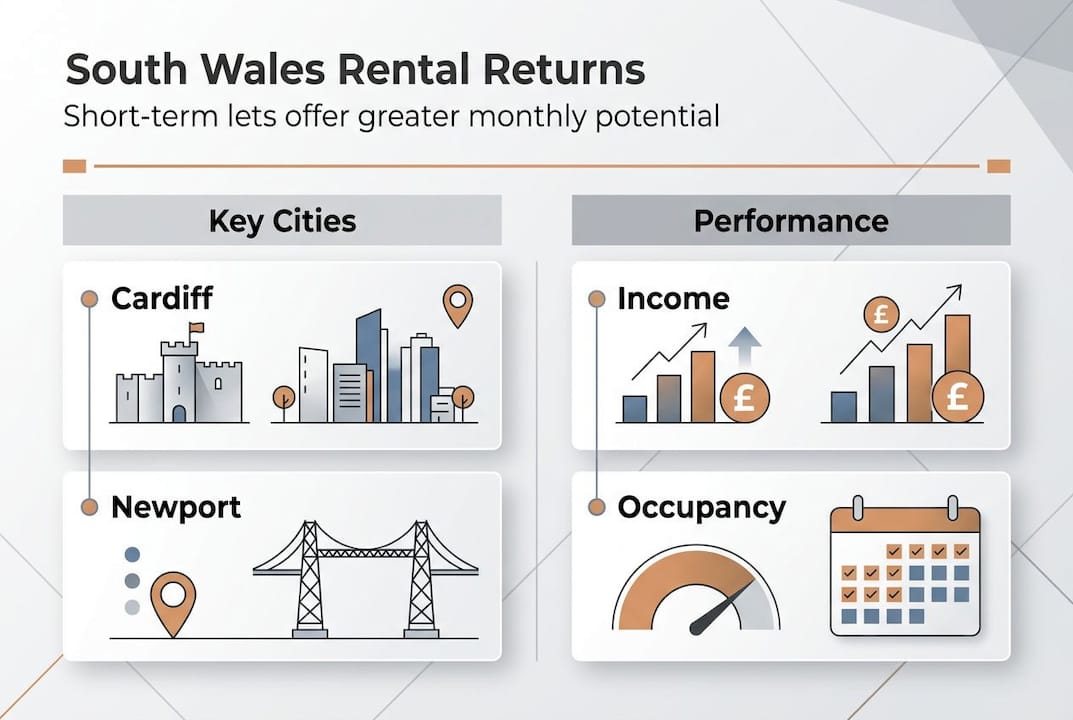
The numbers back this up. According to insideAirbnb ROI’s South Wales data, Cardiff short-term rentals generate an average monthly revenue of around £1,800, with an average daily rate (ADR) of approximately £185 and an occupancy rate of 41%. Newport performs similarly, with monthly revenue near £1,650, an ADR of around £180, and occupancy at 40%.
City | Monthly revenue | Average daily rate | Occupancy rate |
Cardiff | ~£1,800 | ~£185 | 41% |
Newport | ~£1,650 | ~£180 | 40% |
Those occupancy figures might look modest at first glance. But here’s the key insight: short-term rentals charge significantly more per night than a traditional tenancy would generate per night, so even at 40% occupancy, the monthly totals often beat a standard long-term let. That gap is what makes the South Wales market interesting for property owners willing to manage their listings actively.
Several factors are fuelling this demand:
Events and tourism: Cardiff hosts major rugby internationals, concerts at the Principality Stadium, and a busy conference calendar.
Business travel: Newport and Cardiff both attract corporate guests, particularly mid-week, which helps smooth out seasonal dips.
Leisure visitors: The Brecon Beacons, Wye Valley, and coastal areas bring leisure travellers who use Cardiff or Newport as a base.
University activity: Academic events, graduation weekends, and visiting families create reliable demand spikes.
For property owners tracking rental trends in South Wales, the picture is one of steady, diversified demand rather than a single-season spike. That resilience is what separates this market from more volatile tourist-only destinations.
Short-term vs long-term lets: comparing income and workload
Choosing between short-term and long-term letting isn’t just a financial decision. It’s a lifestyle one. Both strategies have genuine merit, and the right choice depends on how much time you can commit, how much income variability you can tolerate, and how you feel about tenant relationships versus guest turnover.
Short-term lets, when managed well, consistently outperform long-term revenue on a monthly basis. But that higher income comes with more moving parts. Every guest stay requires cleaning, linen changes, key handovers, and communication. Multiply that across four or five bookings a month and you’re looking at a part-time job, not a passive income stream.

Long-term lets, by contrast, offer predictability. One tenant, one monthly payment, far fewer touchpoints. The trade-off is that your monthly income will typically be lower, and you have less flexibility to use or sell the property at short notice.
Here’s a straightforward comparison:
Factor | Short-term let | Long-term let |
Monthly income | Higher (variable) | Lower (stable) |
Occupancy | ~40-41% | Near 100% |
Owner involvement | High | Low |
Flexibility | High | Low |
Compliance burden | Increasing | Moderate |
The Welsh short-let licensing rules coming into force between 2026 and 2029 add a new layer of complexity to the short-term side. Owners who previously managed everything informally will need to formalise their operations. That’s a real workload increase.
Here’s how to think through your decision:
Assess your available time. If you can’t commit several hours per week to guest communication and coordination, self-managed STR will quickly become overwhelming.
Calculate your income target. Work out whether the extra STR income justifies the extra effort, particularly once compliance costs are factored in.
Consider your property type. City-centre flats in Cardiff tend to perform better as STRs; suburban family homes may suit long-term tenants better.
Think about flexibility. If you may want to use or sell the property within two years, STR gives you options that a long-term tenancy does not.
Pro Tip: The benefits of STR management through a professional service can effectively bridge the gap, giving you short-term income without the full-time workload. Many owners find this the most practical middle ground.
Understanding new regulations: what South Wales landlords must know
Regulation is the topic that’s making South Wales property owners nervous right now, and understandably so. The Welsh Government is introducing a two-stage framework that will affect every short-term rental in the region.
Here’s what’s happening:
October 2026: Mandatory registration begins for all visitor accommodation in Wales. Every STR property must be registered, regardless of how many nights per year it operates.
2029: A full licensing regime for self-catering accommodation comes into force. This includes requirements for gas and electrical safety certificates, fire risk assessments, and appropriate insurance cover.
Annual costs: Compliance costs are estimated at £75 to £172 per year for registration and licensing fees alone, before any safety works are factored in.
The stated aim of these regulations is to level the playing field between short-term rentals and traditional hospitality businesses, and to address housing availability concerns in popular areas. Whether you agree with that rationale or not, the compliance requirements are real and non-negotiable.
What does this mean practically? If you’re running a Cardiff or Newport STR and you haven’t already started preparing, now is the time. The 2026 registration deadline is closer than it feels, and the 2029 licensing requirements will need safety documentation that takes time to arrange.
Key compliance checklist for South Wales STR owners:
Register your property before October 2026
Obtain a valid gas safety certificate (annual renewal)
Commission an electrical installation condition report
Complete a fire risk assessment
Arrange appropriate public liability insurance
Review your planning position if operating at scale
Pro Tip: Our STR regulations guide for Cardiff and Newport owners breaks down each requirement in plain language, so you know exactly what to prepare and when.
The cost impact is manageable for most owners, but only if they plan ahead. Leaving compliance to the last minute risks fines, delisting from booking platforms, or forced closure during peak revenue periods.
Smart management: reducing workload and maximising returns
Once you understand the income potential and the regulatory landscape, the question becomes: how do you actually run a successful short-term rental without it consuming your life?
Self-management is one option. You control everything, from listing copy and pricing to guest communication and cleaning rotas. For owners with time, local knowledge, and a good network of tradespeople, this can work well. But it requires consistent availability, particularly around check-ins, late-night guest queries, and unexpected maintenance issues.
The alternative is professional management, and it’s worth understanding what that actually involves. A good management firm handles:
Dynamic pricing: Adjusting nightly rates based on demand, local events, and competitor data to maximise revenue.
Guest communication: Responding to enquiries, managing check-ins, and handling issues promptly.
Housekeeping coordination: Scheduling and quality-checking cleans between every stay.
Maintenance oversight: Identifying and resolving issues before they become negative reviews.
Compliance support: Keeping safety certificates current and registration documentation in order.
As WalesOnline has noted, the layered regulatory burden, combining registration, licensing, business rates, and planning considerations, is making some smaller operators reconsider whether self-management is viable long-term. Tourism bodies have raised concerns about over-regulation, but the direction of travel is clear.
For owners who want income with minimal personal involvement, outsourcing to a specialist is increasingly the logical choice. The management fee is offset by better occupancy, higher nightly rates through professional pricing tools, and the time you get back.
Explore Cardiff rental management options and STR management strategies to understand what a structured approach looks like in practice.
Our take: why South Wales STRs are still worth it—if you manage smartly
We’ve worked with South Wales property owners long enough to know that every regulatory announcement triggers the same reaction: panic, followed by paralysis. The 2026 registration and 2029 licensing changes are real, but they are not the end of the short-term rental opportunity here.
The fundamental economics remain strong. Cardiff and Newport monthly STR revenues of £1,650 to £1,800 represent a meaningful premium over long-term letting income in comparable properties. That gap doesn’t disappear because of a registration fee.
What changes is the bar for entry. Casual, informal hosting becomes harder to sustain. Owners who treat their rental like a proper business, with documented processes, professional presentation, and proactive compliance, will thrive. Those who don’t will find the workload increasingly difficult to justify.
Our honest view: the regulation is a filter, not a barrier. It removes the least committed operators, which actually improves the competitive landscape for serious owners. If you’re willing to invest in STR essentials and treat your property as a genuine hospitality business, South Wales remains one of the more compelling short-term rental markets in the UK.
Get more from your South Wales rental with expert management
If the income potential excites you but the compliance and operational demands feel daunting, you don’t have to navigate it alone.

At Guesture, we handle the full picture for Cardiff and Newport property owners: registration and compliance documentation, professional listing setup, dynamic pricing, guest communication, housekeeping coordination, and regular owner reporting. Our property management services are designed specifically for South Wales rentals, so you benefit from local knowledge and proven systems. Whether you’re just starting out or looking to improve an existing listing, explore our services overview to find the right level of support for your property goals.
Frequently asked questions
How much can I earn from a short-term rental in Cardiff or Newport?
According to general data, the typical monthly revenue for Cardiff is around £1,800, and for Newport about £1,650, though results vary by occupancy, location, and property quality.
What are the new legal requirements for short-term lets in South Wales?
From October 2026, all STRs must register with the Welsh Government, and from 2029, self-catering licences will be required, with annual compliance costs estimated between £75 and £172.
Is short-term letting or long-term letting more profitable in South Wales?
Short-term lets typically generate higher monthly income, but lower occupancy rates of around 40 to 41% mean results vary; long-term letting offers more stability with less day-to-day involvement.
Do I need professional management for my South Wales rental?
Professional management isn’t essential, but it significantly reduces the time burden and can improve income through better pricing, guest experience, and compliance handling, making it a practical choice for most busy property owners.
Recommended


Comments